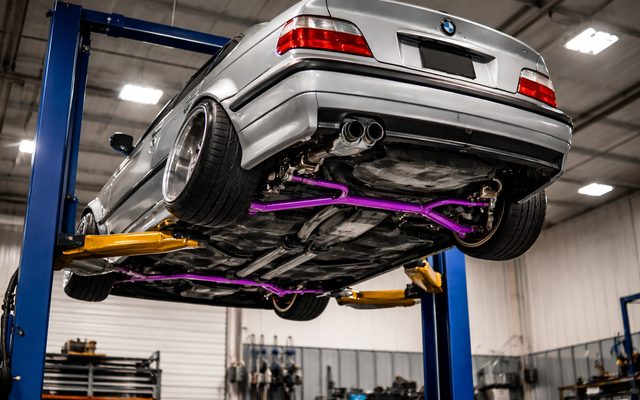
Inside the high-stakes realm of today's serious drifting, victory is not merely purely a result of raw horsepower or driver courage. Rather, it has evolved into a intricate engineering challenge which necessitates a scrupulous blend of selecting a proven chassis, equipping it with the highest-quality performance components, and, most critically, comprehending its real-time behavior on the track through cutting-edge drift telemetry software. This exhaustive guide will serve as your master plan starting from the very first idea of a project car right through to the final data-informed adjustments that turn a strong vehicle into a predictable podium finisher. We will thoroughly explore the methodical process of chassis dynamics adjustment, illustrating how a advanced drift tuning app like GripDial eliminates approximation and offers unmatched visibility into your vehicle's real-world behavior.
The foundation of any successful competitive sliding vehicle is, undoubtedly, the chassis itself. Several cars have achieved renowned reputation within the global oversteer scene due to their inherent handling characteristics, strong design, and the immense ecosystem of specialist support available. Picking the correct platform is the initial and most crucial selection a builder will make. To illustrate, the BMW's E36 3 Series is widely regarded as among the best overall drift cars of history. Its excellent 50/50 weight distribution, coupled with a rear-wheel-drive setup and extremely reliable six-cylinder motors, forms a car that is both forgiving for novices and highly capable in the control of a professional competitor. The evolution of this concept, the BMW E46, refines these attributes with a even more refined structure, broader stance for enhanced confidence, and even a greater degree of turning capability directly from the OEM. A distinct dominant platform in the professional arena is the Corvette C6.
This V8-powered sports car introduces a distinctive set of benefits to the sideways discipline, featuring a light aluminium frame, a rear-mounted transaxle that helps create an ideal weight distribution, and the immense torque of a big LS V8 motor. This blend makes it an absolute force on track, able of entering and sustaining continuous slides with apparently minimal use of power. For those desiring remarkable bang-for-the-buck, the Nissan Z33 rises above as a excellent example. It is delivered from the factory with a robust platform, a effective OEM limited-slip differential, and the smooth VQ35DE motor that provides sufficient performance for mastering and advancing in the sport. Its follow-up, the Nissan Z34, offers further advancements in structural rigidity, suspension design, and peak engine performance, solidifying its position as a favorite choice among professional drivers. Additional historic platforms that warrant mention include the lightweight unique FC generation RX-7, the ever-present S13 Silvia/240SX, the American SN95 generation Mustang, the more recent E90 3 Series, and the compact yet incredibly playful and instructive Mazda Miata. Each of these platforms provides a unique set of traits, challenges, and potentials, but they all have in common the basic ingredients essential to be transformed into a competitive drift machine.
However, picking the correct car is just the starting point. To release the complete performance of any of these cars, significant modifications to the steering and chassis control systems are completely mandatory. This is where the realm of performance tuning components comes into vital importance. The single most transformative improvement for a dedicated drift machine is the fitting of a maximum-angle angle modification kit. These engineered kits, for example those manufactured by industry leaders like SLR Speed, are designed to significantly increase the vehicle's maximum lock-to-lock rotation. A factory production vehicle is highly restricted in how far its tires can turn, a safety trade-off for on-road driving. In sliding, conversely, aggressive countersteering is continuously required to control and maintain a slide. An angle kit replaces the factory uprights, tie rods, and sometimes suspension arms with pieces that allow the front tires to attain angles over 70 or even 80 degrees, as opposed to a normal factory limit of around 40 to 50 °.
This vastly expanded capability provides the driver with dramatically greater command during a slide, making it far simpler to initiate a drift, sustain it through a extended turn, and switch fluidly from one direction to the opposite. The difference in handling is nothing short of transformative. Paired with a correctly chosen angle kit is the equally vital enhancement to the car's damping system. Store-bought or even expensive sport dampers are simply not designed for the specific and extreme demands of sliding. A purpose-built pair of coilovers is paramount. These specialized coilovers feature custom piston tuning and spring rates that are designed for the violent weight transfer that is characteristic of sliding. When a driver begins a angle, the chassis's mass is transferred rapidly to the outside of the corner. Proper drift-spec suspension handle this movement in a consistent way, permitting the car to settle rapidly and providing the driver precise response through the controls and cockpit. They additionally provide precise tuning of stance, rebound and compression rate, and weight balance, which are all key aspects of fine-tuning the vehicle's behavior to a specific venue or piloting technique. Together, a top-tier drift angle kit and a expertly specified set of performance adjustable dampers form the undeniable mechanical foundation upon which all later optimization is based.
Once the fundamental components is in place, the following essential phase in the project is the precise adjustment of the chassis's alignment. This is the world of vehicle alignment optimization, a methodology that can seem overwhelmingly complex to the uninitiated but is, in fact, the key to converting a set of fast components into a harmonious and predictable vehicle. The most discussed element of tuning for oversteer is undoubtedly negative camber. Wheel camber is the angle of the tire in relation to the perfectly straight axis when observed from the front-on of the chassis. When the top of the wheel is leaning towards the chassis, this is called negative camber. For sliding, inward-leaning wheels on the front wheels is universally used and is regarded as critical. The purpose is deeply related to physics.
When a vehicle is turning at high slip angles, the chassis tilts to the external of the bend. This lean forces the outer front wheel to diminish its best grip area with the asphalt. By applying inward lean, the wheel is pre-angled to counteract this tilt. As the chassis leans into the corner, the tire flattens out against the road surface, optimizing its bite at the exact time when it is needed most for control. Typically, front axle adjustments for a serious drift machine vary from approximately -3 degrees to as extreme as -5 degrees or even more, contingent on the details of the chassis setup, tire selection, and pilot preference. The back tires also utilize negative camber, but the values are typically more modest and subtler than the front axle. Excessive camber at the back can result in the chassis excessively tail-happy and difficult to control on power input, as it diminishes the effective grip area of the driving wheels during linear acceleration. Hence, rear adjustments are commonly in the ballpark of drift tuning app -1 degree to -3 degrees, striking car alignment tuning a precise compromise between providing sufficient cornering traction to aid in starting and maintaining the drift while simultaneously maintaining effective hook-up for power-down the bend. Camber is merely one part of the more complex alignment puzzle, which also encompasses toe, self-centering steering, and suspension-induced steering correction.
Toe angle refers to the direction of the tires when viewed from a bird's-eye view. Toe-in means the leading edges of the tires are closer together than the trailing edges, while negative toe means the reverse. For oversteer, a small amount of front negative toe is often employed to quicken the initial response steering reaction, making the chassis feel more agile and willing to begin a slide. Rear toe setting is generally set to neutral or a incredibly small amount of positive toe to promote predictability under power. self-centering is the forward or backwards angle of the suspension pivot when observed from the side of the car. Increased caster angle increases steering feel and high-velocity confidence, and it furthermore adds to negative camber gain during turning, which is extremely useful. Setting these values is a complex interplay where a change to a single setting can and will affect the remaining parameters. The traditional approach for tuning a vehicle's suspension geometry for competition has historically been a labor-intensive endeavor of trial and error. A driver or team would make a change based on experience, drive the car on track, rely on the driver's subjective feel and impressions, and then introduce an additional tweak. This loop would continue again and again until the vehicle felt "good" or the available practice time ran out. This system is not just exceptionally wasteful in terms of hours and tires, fuel, and parts, but it is also fundamentally flawed.
Pilot perception is a infamously unreliable metric, colored by countless factors such as exhaustion, evolving track surfaces, ambient heat, and simply the focus of the operator on that specific day. What feels "tail-happy" on one pass might feel "understeery" on the next lap, causing conflicting information and counterproductive changes. This traditional challenge in chassis setup is precisely where contemporary technology has made its mark to completely change the process.
The development and adoption of specialized suspension tuning applications has ushered in a new paradigm for engineering and optimizing professional drift machines. These platforms, exemplified by cutting-edge products like data acquisition tools, work by directly recording the live mechanical behavior of the car as it is being driven on the course. Unlike relying on personal feedback, these systems gather objective data on essential factors such as suspension travel, corner velocities, lateral and longitudinal g-forces, wheel angle, and driver input position. This collected data stream is then analyzed by powerful software that can plot and analyze the information in a actionable way. For the very first time, tuners and builders can observe specifically what the car is performing at each millisecond of a drift. This ability transforms the whole suspension tuning process. Consider the particular goal of setting the front negative camber for a given car. Instead of making a modification from -3 degrees to -3.5 degrees and then driving several passes to try and "perceive" a difference, a vehicle dynamics tool can give real-time and definitive information. The tool can indicate graphically how the tire's grip is performing during the key moments of a angle: initiation, mid-corner, and transition. It can show if the existing camber setting is permitting the outside front tire to maintain optimal contact or if the rubber is over-stressed on its external edge.
The software can subsequently make empirical recommendations for change. Perhaps the information indicates that the tire is still overloading its sidewall at -3.5 degrees of camber, implying that a move towards angle, say -4 degrees, might be warranted. Conversely, the data might show that the tread is failing to reaching temperature or that the inside edge is wearing excessively, which could point to that there is excessive negative camber and a slight lessening back to -3.2 degrees would be better optimal. This standard of accuracy and actionable analysis was literally unimaginable in the time of solely mechanical tuning.
The benefit of using a comprehensive drift telemetry system goes far beyond only dialing in camber. It serves as an invaluable damper adjustment manual that is customized to your particular vehicle. When adjusting the rebound and compression settings on your suspension, instead of using vague guidelines or copying another team's setup, you can utilize the telemetry to observe how the vehicle is reacting in reaction to your adjustments. The application can show the wheel movement trace over a run, showing if the coilovers are managing the body movement effectively or if they are causing the car to become unsettled uncontrollably after a flick. It can aid in diagnosing problems like excessive compression or losing droop, enabling you to introduce informed choices to spring preload, rebound/compression values, or stance. This methodology translates just as well to the complex task of suspension geometry optimization. In addition to camber, the tool can provide insight into how modifications to toe and caster angle are affecting the car's stability during specific maneuvers of a lap. For example, it can allow you to determine the optimal amount of front axle toe out for your specific steering rack setup and driving technique by measuring the response time of initial reaction and the consistency of the chassis at maximum steering angle. This transforms the tool an exceptionally effective performance optimization handbook that is dynamically calibrated by the actual behavior of your personal chassis on the circuit. It elevates the whole project from a dark art into a repeatable optimization procedure.
Furthermore, the application of a tool like GripDial is not at all confined to experienced teams with large resources. For the amateur enthusiast, it acts as an incredible force multiplier. It effectively gives the driver with the knowledge of a full-time suspension specialist without needing the corresponding cost. It accelerates the tuning process by giving definitive solutions to questions that would traditionally take seasons of experimentation to answer. A builder can learn how their individual chassis reacts to various settings, gaining a more intuitive comprehension of vehicle dynamics in the journey. It additionally democratizes advanced chassis dynamics techniques, allowing anyone with the desire to refine their car to do so in a efficient and effective manner. This is particularly valuable in a activity like sliding, where setup knowledge has in the past been a tightly held asset among professional teams. Now, that power can be in the toolkit of every dedicated enthusiast.
In summary, the path to building and optimizing the ideal competitive drift machine is a comprehensive project that smoothly blends time-honored engineering principles with cutting-edge digital technology. It begins with the strategic pick of a legendary car, then built upon the application of essential drift-spec parts like high-performance steering angle kits and correctly valved drift-spec suspension units. The process then progresses into the detailed stage of car suspension tuning, where values like camber angle, toe, and caster angle are carefully configured to match the vehicle's modified geometry and the driver's personal technique. Ultimately, and what truly distinguishes the contemporary approach from the old ways, is the integration of a sophisticated suspension tuning application. This platform eradicates the guesswork and trial and drift angle kits error of purely seat-of-the-pants adjustment by providing quantifiable, live information on how the vehicle is truly functioning. It functions as an incredible diagnostic aid, a definitive alignment optimization handbook, and a master performance analyzer. As a complete package, this integrated methodology ensures that each and every element of the drift car—from the selection of the chassis to the most minute tweak on the coilover—is refined for peak success on the competition venue. It represents the complete progression of the art of drifting, connecting raw driving skill with precise chassis dynamics to build the most dominant cars attainable.